Medical-Grade Stainless Steel Tubing: What Makes a Steel Tube "Medical-Grade"
"Medical-grade stainless steel tubing" is not a trade name for a single, specific alloy; rather, it refers to a category of stainless steel tubing that meets stringent requirements for material composition, surface condition, dimensional precision, and biological safety, making it suitable for medical or sanitary applications. This category encompasses both small-diameter precision tubing—used in surgical instruments, hypodermic needles, catheters, and endoscopes—and sanitary-grade piping systems employed for the transport of liquids or gases in hospital water supply networks, pharmaceutical manufacturing, and bioprocessing. Even when made from the same 316L alloy, industrial-grade tubing (produced to general standards) and sanitary-grade tubing (produced to specialized hygienic standards) may differ fundamentally in their suitability for use in sterile environments or in applications involving contact with bodily fluids.
In terms of material, 316L is the grade most frequently specified for medical applications. Its carbon content is kept below 0.03%—not merely for the sake of "higher purity," but to minimize the precipitation of chromium carbides at grain boundaries following welding, thereby preventing the formation of zones susceptible to intergranular corrosion near the weld. Furthermore, the 2%–3% molybdenum content in 316L results in a Pitting Resistance Equivalent Number (PREN) typically ranging from 24 to 28. This ensures a significantly more stable passive film compared to 304 (which has a PREN of approximately 18) when exposed to chloride-containing disinfectants, saline solutions, or bodily fluids. While 304 is not entirely excluded from the medical sector—finding use in non-implantable instruments, equipment frameworks, or environments with limited chloride exposure—316L is generally the more reliable choice for applications involving blood contact, frequent chemical disinfection, aseptic processing, or components fabricated via welding.
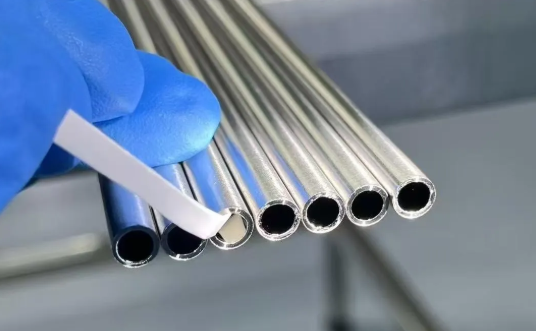
The most clear-cut distinction between "medical-grade" and standard stainless steel tubing lies in the standards to which they are manufactured. ASTM A269 covers austenitic stainless steel tubing for general service and imposes no specific, controlled requirements for surface finish. In contrast, ASTM A270 is the standard for sanitary-grade tubing; it builds upon A269 by incorporating specifications for controlled surface finish, supplementary requirements for pharmaceutical-grade applications, and strict standards for sanitary cleanliness. Furthermore, it mandates tighter dimensional tolerances to ensure precise alignment between tubes and fittings, which is essential for automated orbital welding. In short, if an application involves food, pharmaceuticals, bioprocessing, or sterile fluids—where the surface condition directly impacts the effectiveness of cleaning and sterilization—then A270 is the appropriate standard. A269, meanwhile, is better suited for instrumentation, hydraulic systems, or general mechanical applications.
Surface finish is the most critical physical indicator of "medical-grade" quality. Bright-annealed (BA) tubing typically has a surface roughness (Ra) of ≤ 0.4 μm, making it suitable for use in operating rooms, general laboratories, and high-purity gas delivery systems. Electropolished (EP) tubing—produced by subjecting BA tubing to an electrochemical process—can achieve an Ra value of ≤ 0.2 μm, with high-end products reaching below 0.05 μm; such tubing is used in biopharmaceuticals, aseptic processes, and for precision components that come into direct contact with the human body. The ASME BPE standard further categorizes surface finishes into grades ranging from SF0 to SF6: SF1–SF3 correspond to mechanical polishing, with an upper Ra limit of approximately 0.51–0.80 μm, while SF4–SF6 correspond to electropolishing, with an upper Ra limit of approximately 0.38–0.64 μm. A smoother surface reduces the likelihood of bacterial adhesion and biofilm formation, and simplifies the process of cleaning validation—which is the fundamental reason why medical-grade tubing justifies the higher cost associated with the electropolishing process.
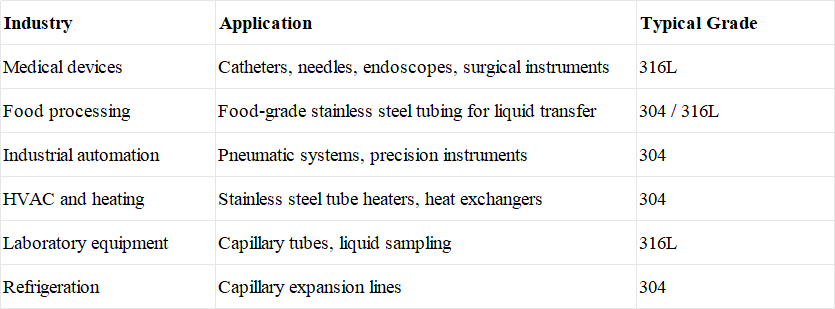
When examining material selection logic from the perspective of end-use applications, it becomes clear that the requirements for "medical-grade" materials vary depending on the specific scenario. For hypodermic needles, catheters, endoscopes, and surgical instruments, 316L precision tubing is typically chosen; these tubes can feature outer diameters as small as 0.1–6 mm and wall thicknesses of 0.05–1 mm, with dimensional tolerances controlled to within ±0.01 mm to ensure precise puncture capabilities and accurate fluid control. In contrast, piping systems for clean water supply in hospitals, as well as those used in operating rooms and ICUs, must balance pressure resistance, compatibility with sterilization processes, and installation reliability—often utilizing 316L sanitary-grade tubing joined via double-press or circumferential-press fittings. For tubing intended for contact with human tissue or blood, biocompatibility is evaluated in accordance with the ISO 10993 or GB/T 16886 series of standards, with a focus on risks such as cytotoxicity, sensitization, and the leaching of metal ions. Understanding these contextual differences is far more valuable than simply memorizing a specific material grade or a particular surface roughness (Ra) value when determining whether a given stainless steel tube is truly "medical-grade" for a specific project.