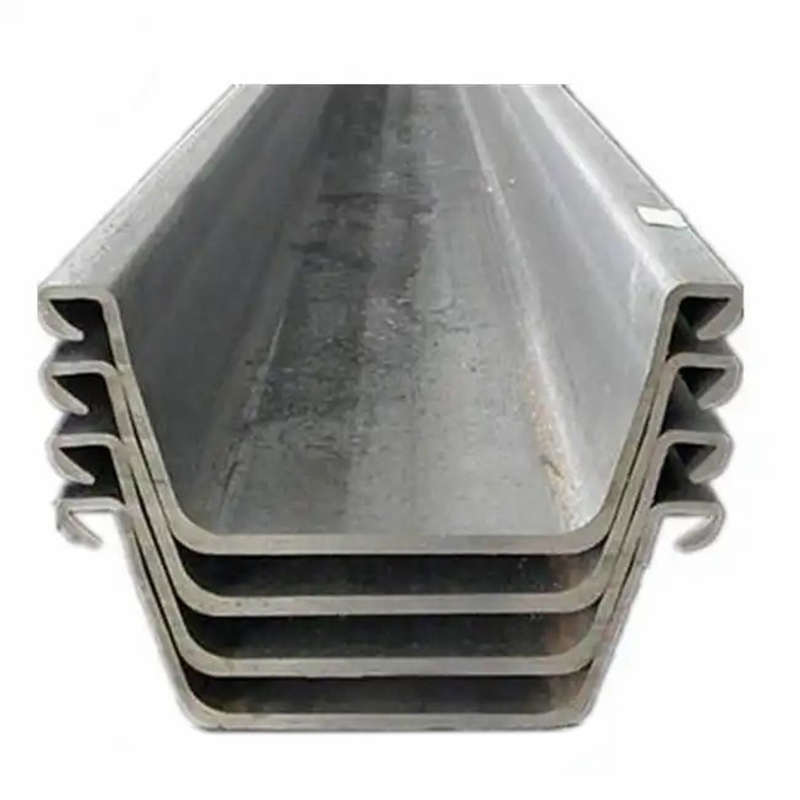
Main advantages and uses of steel sheet piles
Steel sheet piles are high-strength steel materials (commonly Q235 and Q345) manufactured through hot rolling or cold bending processes. They are primarily used in civil engineering as support or retaining structures. Compared to traditional concrete solutions, they offer significant advantages such as faster construction speed, reusability, and strong adaptability to complex geological conditions, making them widely used in foundation pit, cofferdam, and breakwater projects. The following section will introduce them from two aspects: core performance and typical applications.
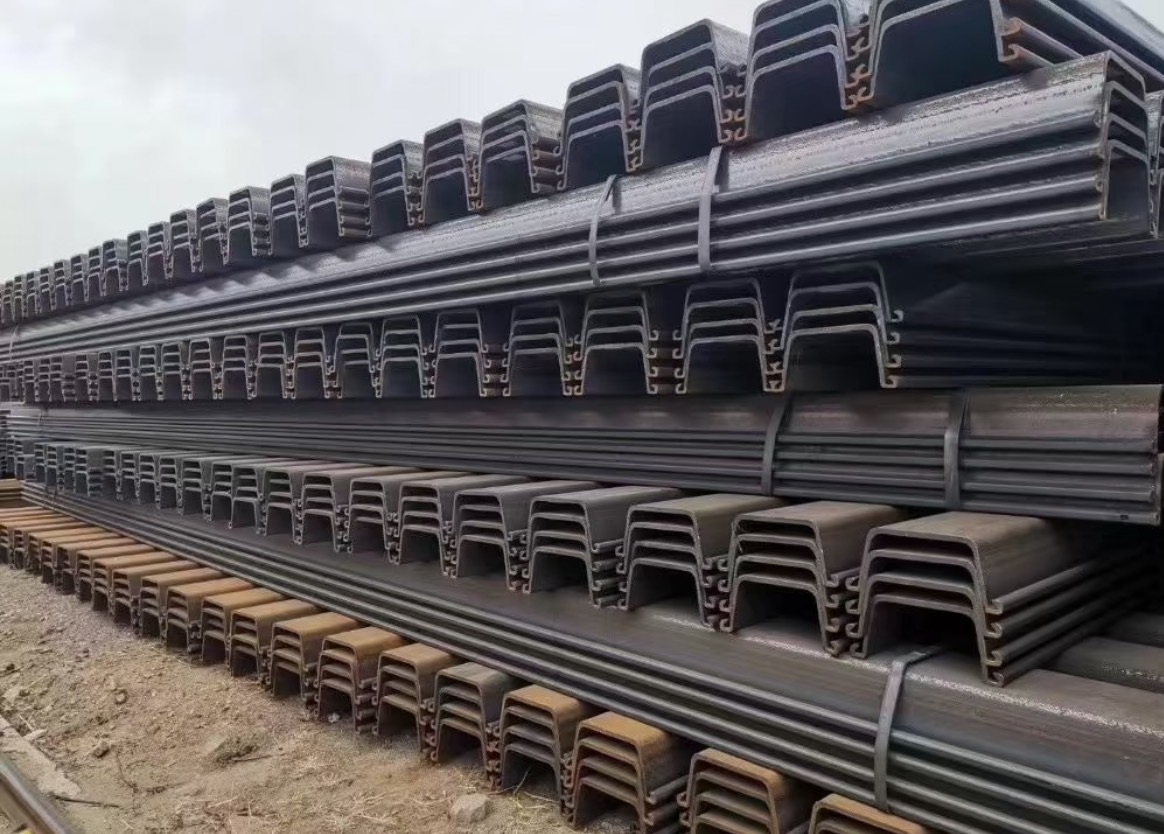
I. Main Advantages
Steel sheet piles exhibit excellent bending resistance. Taking a U-shaped section as an example, their bending section modulus can reach 500–2000 cm³/m, and their moment of inertia is approximately 3–5 times that of ordinary concrete piles, effectively withstanding soil and water pressure in deep foundation pits. During construction, using a vibratory hammer or static pressure equipment, each pile is driven into the ground in just 2–5 minutes, requiring no concrete curing, thus shortening the construction period by 30%–50% compared to traditional support methods. Furthermore, the recycling rate of steel sheet piles exceeds 95%, and a set of piles can be reused more than 10 times (compliant with GB 50017-2017), significantly reducing material waste and construction debris. Even under harsh conditions such as soft soil, sand layers, or underwater (permeability coefficient > 10⁻⁴ cm/s), interlocked continuous walls remain stable, a feature unmatched by concrete piles.
II. Main Applications
In temporary engineering projects, sheet piles are commonly used for deep foundation pit support in high-rise building basements and subway stations, with support depths reaching 20–30 meters (e.g., the Shanghai Tower foundation pit uses SP-IV type piles, reaching a depth of 28 meters). They can also be used to quickly construct cofferdams for bridge piers or port construction, with a single row of piles achieving a seepage resistance height of 5–8 meters. As a permanent structure, sheet piles are widely used in breakwaters, revetments (e.g., the Dutch Delta project resisting waves over 5 meters high), and underground utility tunnels (the exterior walls of the utility tunnel in Tokyo, Japan, simultaneously provide support and waterproofing). In special scenarios, by sealing the interlocking joints, they can also be used to create pollution isolation walls, blocking the spread of groundwater pollution (a recommended solution by the US EPA). Laying sheet piles on soft soil foundations can form temporary roadbeds with a bearing capacity of 150–200 kPa.
III. Economic Considerations
Taking a 10-meter deep foundation pit as an example, the overall cost of steel sheet piles is approximately 60%–70% of that of concrete piles, with a construction period reduction of over 30% (data from a 2021 study in the *Chinese Journal of Geotechnical Engineering*). This economic advantage is even more pronounced for short-term projects or projects with variable geological conditions. Furthermore, steel sheet piles conform to mainstream international standards (such as EN 10248 and ASTM A328), and commonly used PU and AZ series specifications are readily available in bulk. Rental or segmented construction costs are also lower, making it an ideal support solution that balances efficiency, environmental friendliness, and reliability.